Robotic Piece Picking: Machine Vision, Grip Physics & Kinematics
An engineering deep-dive into each-picking automation: stereoscopic point cloud segmentation, adaptive pneumatic vacuum end effectors, collision-free joint kinematics, and automated singulation for non-rigid inventory.
1. The Each-Picking Bottleneck in Fulfillment Operations
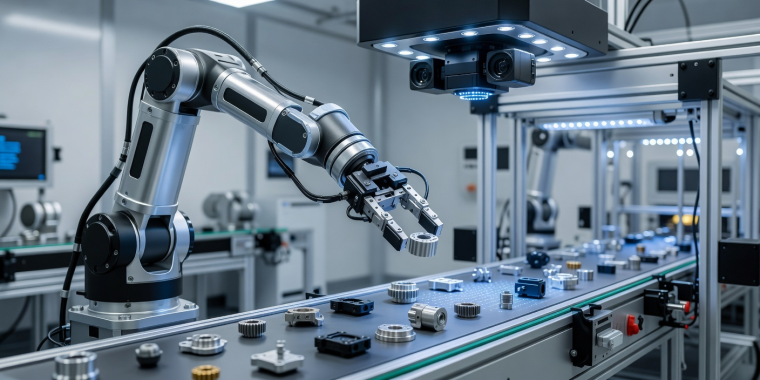
Pallet-load handling and full-case conveyance are mature, highly predictable engineering disciplines. In contrast, "each picking"—the singulation and packaging of individual units from unstructured or disorganized inventory bins—has historically demanded manual human touch. The sheer diversity of modern consumer inventory, ranging from rigid square cosmetic boxes to deformable transparent polybags and cylindrical containers, presents severe perceptual and mechanical hurdles for automated machinery.
Automated robotic piece picking overcomes this barrier through the convergence of three subsystems: high-speed 3D stereoscopic vision, neural surface segmentation, and compliant multi-cup pneumatic tooling. Rather than programming fixed coordinate routines, modern robotic picking cells calculate grasping postures dynamically for every SKU presentation cycle.
End-Effector Physics: Vacuum vs. Mechanical Pincers
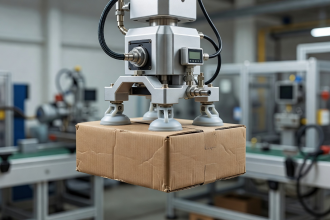
In general industrial picking, pneumatic vacuum manipulation dominates over two-finger mechanical grippers. Suction cups require only a single accessible surface plane, whereas mechanical pincers require clearance around both sides of the target item—a geometric impossibility in tightly packed or chaotic tote bins.
Leading end effectors integrate multi-bellows silicone cups driven by localized Venturi vacuum generators or external high-volume regenerative blowers. When the cup touches an item, pressure transducers register the vacuum drop. If the seal fails due to a porous cardboard surface or loose plastic bag seam, the controller immediately vents the circuit, rotates the wrist axis, and attempts an alternate grasping vector without triggering an emergency system fault.
2. Machine Vision and 3D Volumetric Segmentation
A picking robot is only as capable as its spatial perception. Conventional 2D machine vision cannot reliably isolate touching items sharing identical packaging colors. Robotic cells consequently utilize active structured-light or stereoscopic time-of-flight (ToF) cameras mounted overhead or directly on the robot's seventh axis.
The vision pipeline executes three algorithmic passes in sub-second intervals:
- Point Cloud Generation: Generating hundreds of thousands of XYZ coordinate coordinates reflecting the contents of the bin.
- Neural Surface Segmentation: Partitioning contiguous surfaces into distinct physical entities, recognizing boundaries obscured by crinkled cellophane or overlapping edges.
- Affordance Ranking & Grasp Planning: Evaluating candidate grasp points based on surface normal vectors, estimated centroid location, and collision-free clearance between the tool flange and the rigid bin walls.
3. Kinematics, Cycle Acceleration, and Exception Routing
Maximizing sustained picks requires smooth kinematics rather than reckless joint speeds. Sudden acceleration spikes cause air leakage beneath suction cups, leading to mid-transit drops. Modern industrial manipulators execute time-optimal polynomial spline trajectories, coordinating the motion of all six rotational axes simultaneously to maintain stable vacuum seals during rapid directional transfers.
When an item cannot be picked after consecutive attempts—often caused by reflective packaging blinding the optical sensor or an item exceeding payload mass limits—the cell executes automated exception handling. Rather than stalling the workstation, the tote is indexed forward, and the system diverts the container to an adjacent human-assisted consolidation station.
| Manipulator Architecture | Degrees of Freedom | Typical Reach Envelope | Operational Specialty |
|---|---|---|---|
| 6-Axis Articulated Arm | 6 Rotational Joints | 1.2m to 2.0m spherical radius | Deep tote reach-in, complex wrist tilting, high versatility. |
| Delta Parallel Robot | 3 to 4 Parallel Kinematic Arms | 600mm to 1200mm circular planar | Ultra-high-speed planar pick-and-place from flat belt conveyors. |
| SCARA Manipulator | 4 Joint (Selective Compliance) | 400mm to 800mm cylindrical | Compact secondary kitting, rigid vertical assembly actions. |
| Gantry Cartesian Robot | 3 Linear Orthogonal Axes | Scalable across entire aisle width | Heavy layer-picking, pallet slip-sheet placement, large totes. |
System Strengths (Good for)
- Continuous Multi-Shift Picking: Uninterrupted each-picking operations during overnight sorting cycles without ergonomic fatigue.
- Predictable Task Pacing: Consistent presentation of picked SKUs to outbound bagging, box erection, and label application machines.
- Ergonomic Risk Mitigation: Relieving human workers from repetitive twisting and deep reaching motions inside heavy shipping containers.
- Integration with Goods-to-Person: Operating seamlessly alongside shuttle automated storage and retrieval systems (ASRS).
Engineering Constraints (What to consider)
- Surface Packaging Limitations: Highly porous fabrics, oily surfaces, or heavy open-mesh items resist standard vacuum suction.
- Lighting & Optical Glare: Inconsistent warehouse ambient skylights can distort 3D depth cameras, requiring calibrated cell shrouding.
- Tote Lip Interferences: Grasping items resting flush against vertical plastic tote walls risks mechanical flange collisions.
- High Compressed Air Demand: Continuous Venturi vacuum usage requires substantial, clean, dry instrument air supply.
Robotic Picking Implementation Checklist
- Conduct a SKU profile audit to measure packaging dimensions, surface porosity, and minimum/maximum product weights.
- Verify adequate supply of dry, filtered compressed air (typically 6 to 7 bar) with dedicated pressure accumulators.
- Design physical perimeter safety fencing with interlocked light curtains compliant with ISO 10218-1 and ISO 13849.
- Establish dedicated reject and human-exception bypass lanes so pick failures do not stall inbound conveyor queues.
- Calibrate overhead camera coordinate matrices against robot tool flange base frames using precision calibration balls.
Technical Robotic Cell Reviews
Evaluating automated piece picking feasibility or gripper air consumption metrics? Transmit your technical inquiries to our desk.
Submit Engineering Question