Autonomous Mobile Robots: Fleet Dynamics, Localization & Payload Physics
An engineering breakdown of autonomous mobile robots (AMRs) and automated guided vehicles (AGVs), evaluating continuous SLAM mapping, dynamic obstacle recovery, opportunity battery chemistry, and fleet supervisor protocols within live distribution facilities.
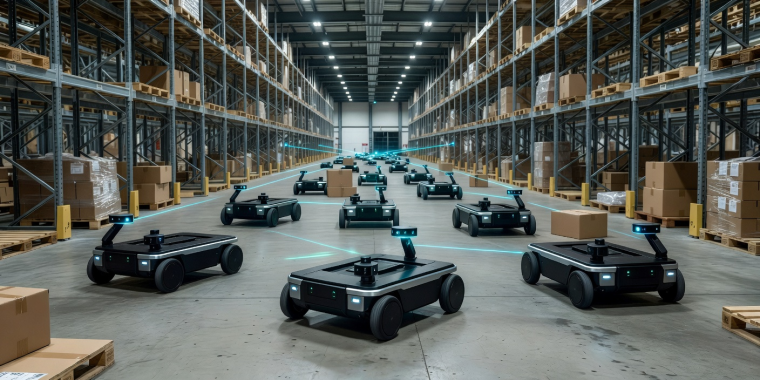
1. The Mechanical and Algorithmic Separation: AMRs vs. AGVs
Within contemporary intralogistics engineering, autonomous mobile robots (AMRs) and automated guided vehicles (AGVs) represent distinct technical paradigms despite sharing operational objectives. An AGV operates under deterministic guidance architectures, relying on physical floor tracks such as inductive magnetic tapes, embedded wire coils, optical floor barcodes, or passive RFID transponders. When an AGV detects an obstruction in its travel path, its onboard safety relay transitions to an open circuit, halting the chassis until human intervention clears the obstacle.
Conversely, an autonomous mobile robot utilizes simultaneous localisation and mapping (SLAM). Rather than following fixed physical infrastructure, an AMR continuously reconciles live observations from safety-rated time-of-flight LiDAR sensors, stereoscopic depth cameras, and wheel odometry encoders against a cached topological facility map. When confronted by a stationary barrier—such as a misplaced transport tote or staged pallet—the onboard trajectory planner calculates alternative spline trajectories within pre-allocated safety corridors, enabling dynamic navigation around obstructions without manual operator resets.
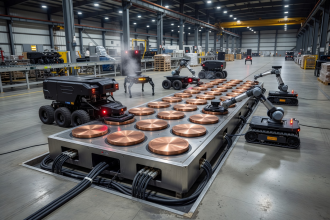
Energy Management: Opportunity vs. Swap Chemistries
Fleet availability depends on battery replenishment planning. While historic automated guided vehicles frequently required battery exchange gantries and manual lead-acid swaps, modern AMRs predominantly utilize Lithium Iron Phosphate (LiFePO4) or Lithium Nickel Manganese Cobalt (NMC) chemistries capable of high C-rate opportunity charging.
During brief idle intervals—such as queueing at a goods-to-person station or waiting for an elevator transit—the vehicle engages automated copper contact pads mounted flush with the floor or along peripheral walls. A continuous 10-minute top-off cycle maintains state-of-charge between 30% and 80%, avoiding thermal runaway risks and preventing sustained vehicle lock-outs.
2. Navigation Modalities and Localization Drifts
In vast distribution centres spanning tens of thousands of square metres, maintaining sub-centimetre robot localisation poses acute challenges. Natural-feature SLAM relies heavily on structural columns, exterior walls, and fixed storage racks. However, in environments with homogeneous high-bay aisles or dynamic staging areas where pallet clusters shift daily, standard optical 2D LiDAR encounters "hallway symmetry" and geometric ambiguity.
To eliminate odometry slip caused by smooth polyurethane drive wheels traversing industrial floor joints, modern systems implement multi-modal sensor fusion. Extended Kalman Filters (EKFs) synthesize input from:
- Dual Horizontal LiDARs: Placed at diametric corners of the chassis to deliver a 360-degree planar safety boundary.
- Downward-Facing Optical Sensors: Detecting high-contrast matrix fiducials (QR codes) or tracking concrete surface textures to reset cumulative wheel slippage.
- Micro-Electro-Mechanical (MEMS) IMUs: Measuring 6-degree-of-freedom acceleration and angular velocity during sharp pivot maneuvers.
- 3D Stereo Cameras: Pointed slightly upward or forward to monitor overhang hazards, protruding pallet forks, and low-hanging mezzanine structures missed by planar scanners.
3. Fleet Management Protocols and Traffic Allocation
Deploying a single AMR is fundamentally an exercise in robotics; deploying eighty AMRs is an exercise in distributed network queuing and deadlock prevention. The supervisory Fleet Management System (FMS) coordinates task assignment from the host Warehouse Management System (WMS), translating high-level transport orders into discrete destination nodes.
Traffic arbitration commonly utilizes topological graph networks. Pathways are mapped as directional edges connected by intersection nodes. When multiple robots converge on a two-way aisle, the FMS applies reservation-based scheduling: the second arriving unit yields at a designated passing pocket or is redirected along an adjacent parallel aisle. Without rigorous topological reservations, autonomous units can suffer mechanical deadlocks—mutually blocking each other while their collision-prevention envelopes overlap.
| Evaluation Factor | Natural-Feature AMR | Fiducial / Grid Guided AMR | Conventional Magnetic AGV |
|---|---|---|---|
| Facility Civil Modification | Minimal; relies on ambient warehouse architectural landmarks. | Moderate; requires precise floor matrix drilling or barcode stickers. | Extensive; magnetic tape application or sub-floor slot cutting required. |
| Obstacle Trajectory Adaptability | High; dynamically negotiates alternate splines around barriers. | Low; pauses or requests alternative orthogonal grid coordinates. | None; halts automatically on path obstruction until manually cleared. |
| Localisation Tolerance | Typically ±10mm to ±25mm without secondary guidance. | Sub-5mm repeatability directly over optical markers. | ±2mm to ±5mm following magnetic field line. |
| Integration Complexity | High initial fleet simulation; software-centric route tuning. | Medium; predictable route networks with rigid node spacing. | Medium mechanical; highly rigid commissioning requirements. |
System Strengths (Good for)
- Brownfield Adaptability: Operational facilities where cutting floor channels or installing overhead conveyor gantries is structurally unviable.
- Dynamic SKU Profile Changes: Distribution centres requiring seasonal reconfiguration of pick lines and buffer staging areas without civil construction.
- Decoupled Scalability: Incrementally scaling transport throughput by injecting additional chassis units into the existing fleet supervisor.
- Ergonomic Goods-to-Person: Transporting entire storage racks directly to stationery picking personnel, drastically reducing foot travel.
Engineering Constraints (What to consider)
- Floor Slab Quality: Highly polished, uneven, or oily concrete causes drive wheel slippage and compass heading errors in IMU filters.
- Dynamic Clutter Blindspots: Overhanging inventory or thin shrink-wrap film may remain undetected by safety LiDAR, requiring secondary stereoscopic cameras.
- Wi-Fi Handshake Latency: Uninterrupted roaming across industrial 5GHz or private cellular APs is required to prevent emergency brake trips.
- Safety Certification: Site compliance mandates adherence to ISO 3691-4, defining dynamic safety fields tailored to chassis velocity and stopping distances.
AMR Engineering Implementation Checklist
- Perform detailed floor flatness surveys (F-min or TR34 standards) to detect ramps exceeding robot grade limitations.
- Verify that maximum payload mass including carrier pallet weight does not exceed continuous motor drive torque thresholds.
- Establish dedicated, non-combustible charging zones compliant with regional industrial battery storage regulations.
- Conduct electromagnetic field (EMF) and Wi-Fi signal attenuation mapping throughout high-density steel pallet racks.
- Define manual bypass routes and emergency pull-cords to satisfy local occupational health safety inspectors.
Consult Our Automation Research Desk
Have technical questions regarding autonomous vehicle integration, wheel payload capacities, or fleet software topologies?
Submit Engineering Inquiry