Conveyor Mechanics & High-Speed Sortation Topology
An in-depth systems examination of modern unit-load conveyor engineering: brushless motorized drive rollers, optical accumulation zones, loop cross-belt sorters, transfer diverters, and noise-damping controls.
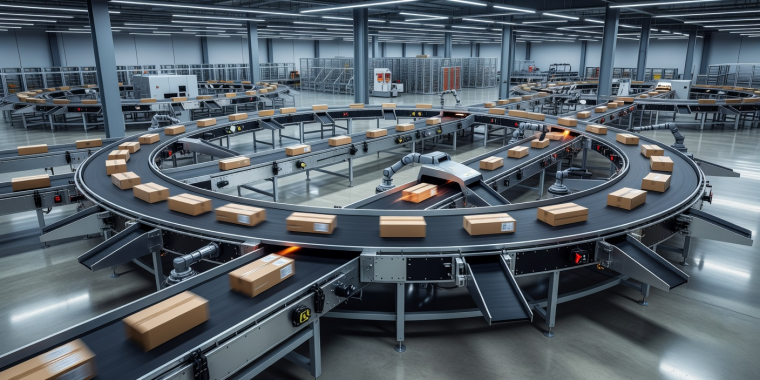
1. The Mechanical Foundation: Continuous vs. Decoupled Transport
While flexible automated mobile robots have captured broad industry attention, fixed conveyor infrastructure remains unmatched in sustained unit-load velocity and peak volumetric transport. When a modern distribution centre must transport twenty thousand cartons per hour from an automated high-bay reserve to thirty outbound packing lanes, continuous motorized conveyors provide the requisite structural throughput without the battery swapping overhead or corridor congestion inherent to mobile fleets.
However, fixed conveyors fundamentally permanently partition floor space. Installing a trunk line divides the floor, requiring dedicated personnel crossings, structural underpasses, or overhead mezzanine elevation. Therefore, specifying conveyor systems demands an acute understanding of load mass tolerances, friction coefficients, packaging integrity, and drive electronics.
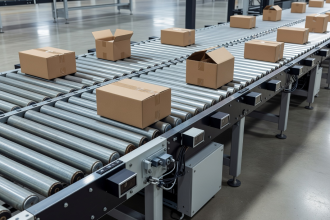
Zero-Pressure Accumulation (ZPA) Architecture
In legacy gravity and lineshaft conveyor systems, halting downstream product flow resulted in "line pressure"—where upstream cartons pushed continuously against stalled items, crushing fragile corrugated boxes and wedging irregular items off track.
Modern distribution beds rely on Zero-Pressure Accumulation (ZPA). The conveyor bed is divided into discrete electromechanical zones (typically 600mm to 1000mm in length). Each zone features one 24V or 48V brushless Motorized Drive Roller (MDR) mechanically coupled to adjacent passive slave rollers via poly-V or elastomeric O-rings.
A retro-reflective or diffuse photoelectric sensor monitors carton presence. When Zone B is occupied and downstream Zone C is stopped, Zone B’s internal motor brake dynamically engages, staging the product with zero physical contact against its predecessor.
2. Sortation Mechanics: Diverters, Pop-Ups, and Cross-Belt Loops
Sortation equipment represents the computational fork in material handling. As products travel along central trunk lines, they must be singulated, oriented, scanned, and diverted into exact shipping lanes corresponding to transport destinations or regional carrier hubs. Selection depends on carton mass, surface texture, and required hourly piece throughput:
- Pop-Up Steering Wheel Diverters: Skewed polyurethane wheels raise vertically between conveyor rollers to pivot cartons at 30-to-45-degree angles into take-off spurs. Ideal for rigid cartons up to 35kg at moderate rates.
- Sliding Shoe Sorters: Continuous extruded aluminium slats where mechanical polymer shoes glide laterally across the bed, smoothly pushing items into diversion chutes. Capable of handling high-velocity, mixed-size items without shock impact.
- Closed-Loop Cross-Belt Sorters: Individual carrier carriages linked in an endless carousel. Each carriage contains a bi-directional motorized miniature conveyor belt mounted perpendicular to the track. When passing the target discharge chute, the belt accelerates, actively ejecting the parcel at speeds up to 3 metres per second.
- Tilt-Tray Sorters: Mechanical trays hinged along a central spine that tip laterally into chutes using mechanical cam guides or linear induction actuators. Suited for rigid apparel trays, books, and envelope mail.
3. Acoustic Control, Energy Management, and Maintenance Access
The operational overhead of extensive conveyor networks is predominantly mechanical wear, electrical baseline consumption, and acoustic fatigue. Historical pneumatic diverters and continuous AC line shafts generated ambient noise levels exceeding 82 dBA, causing auditory fatigue for warehouse floor staff.
Modern facilities achieve sub-68 dBA noise ceilings by shifting from pneumatic pistons to servo-driven electromechanical actuators, utilizing grooved precision urethane roller belts, and implementing "run-on-demand" control logic. When the supervisory PLC detects that an accumulation zone has been unoccupied for more than 15 seconds, the MDR controller sleeps the brushless motor, slashing idle power draw and substantially extending bearing lifespans.
| Sortation Topology | Product Compatibility | Typical Velocity Spectrum | Maintenance Complexity |
|---|---|---|---|
| Pop-Up Roller / Wheel | Flat-bottom rigid cartons and standard plastic totes. | 1.0 m/s to 1.8 m/s; moderate line spacing required. | Low; localized drive belts and pneumatic/servo cylinders. |
| Sliding Shoe Sorter | Diverse cartons, rigid plastics, and wood flats. | 1.5 m/s to 3.0 m/s; gentle continuous deflection. | Medium; regular slat inspection, guide track lubrication. |
| Cross-Belt Carousel | Cartons, polybags, soft parcels, and irregular mail. | 2.0 m/s to 3.5 m/s; precise perpendicular ejection. | High; requires individual cart motor and contact brush monitoring. |
| Spiral Gravity Chutes | Passive downward vertical conveyance without power. | Regulated by friction liner and pitch angle. | Minimal; wear inspection of fiberglass or steel skin. |
System Strengths (Good for)
- Continuous Peak Volume: Unrivaled throughput for steady high-velocity streams between bulk receiving, packing, and dispatch docks.
- Multi-Level Vertical Integration: Connecting multi-story mezzanines and picking platforms via continuous spiral elevators with compact footprints.
- In-Line Automated Verification: Facilitating high-speed weighing, 5-sided barcode camera scanning, and dimensioning tunnels on the fly.
- Predictable Transport Time: Deterministic transit durations allowing synchronized routing to outbound staging trailers.
Engineering Constraints (What to consider)
- Fixed Facility Footprint: Creates permanent physical corridors that obstruct forklift and human pedestrian floor traffic.
- Single-Point Vulnerabilities: A jammed mechanical roller or severed main belt can stall an entire picking sector without bypass spurs.
- Acoustic and Thermal Load: Extensive networks of AC motors require localized heat dissipation calculations in ambient distribution facilities.
- Packaging Geometry Sensitivity: Polybags with loose tails or warped cardboard bottoms can snag in roller gaps, causing catastrophic pile-ups.
Conveyor Engineering Implementation Checklist
- Calculate maximum live carton weight to verify roller diameter and wall thickness against shaft deflection limits.
- Verify that minimum parcel dimensions exceed three times the center-to-center roller pitch to prevent item tipping.
- Install emergency E-stop pull-cords along the entire accessible conveyor perimeter in compliance with ISO 13850.
- Integrate photoelectric zero-pressure accumulation sensors with clear fieldbus communication (e.g., EtherNet/IP, PROFINET).
- Ensure minimum 900mm maintenance access clearance along all non-drive side frame channels.
Conveyor Systems Peer Review
Evaluating accumulation zone densities, motor roller duty cycles, or cross-belt diverter layouts for an upcoming project?
Transmit Systems Question